

Jehmlich Organ from Szombathely v.2

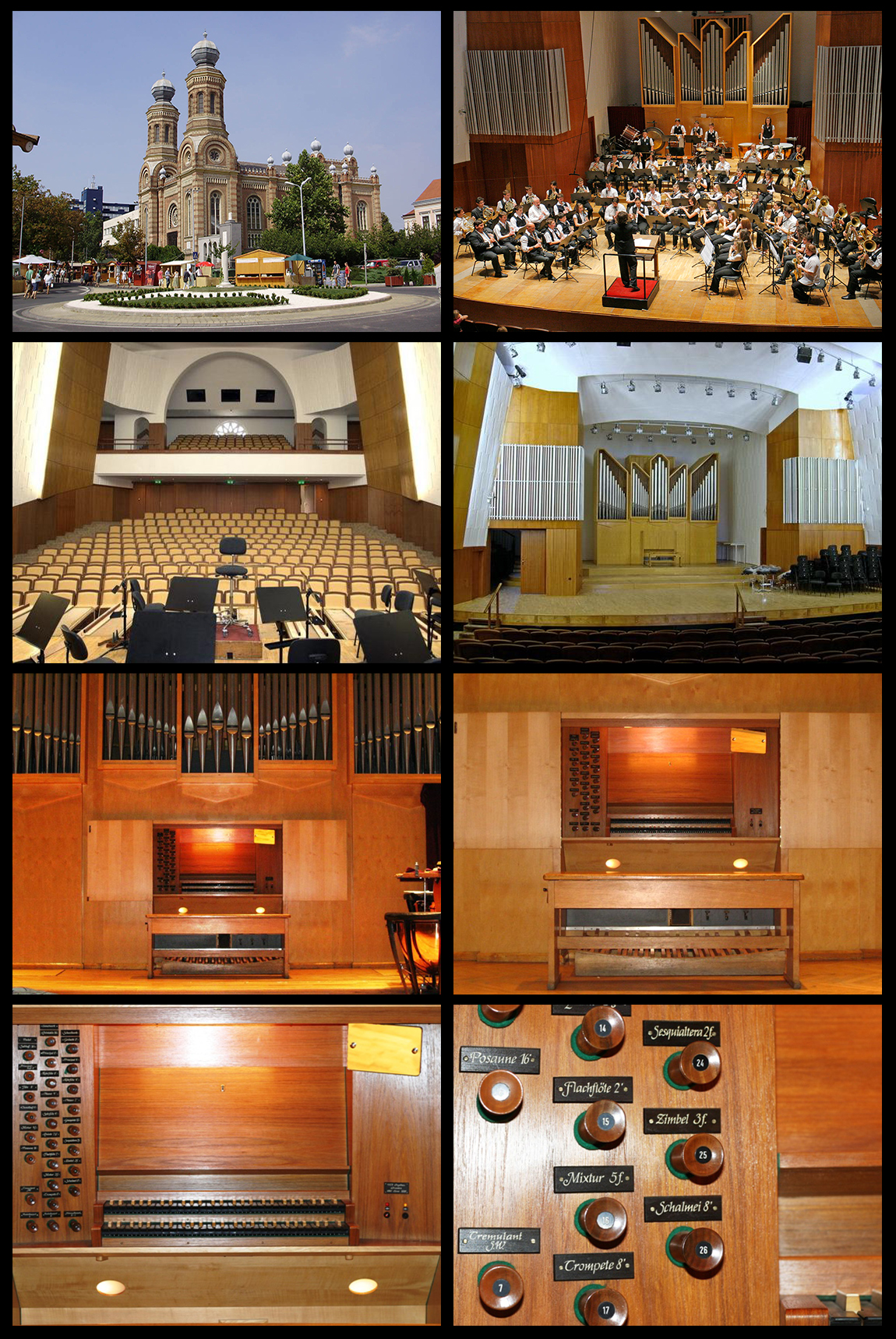
Szombathely is the oldest recorded city in Hungary. It was founded by the Romans in 45 AD under the name of Colonia Claudia Savariensum (Claudius' Colony of Savarians), and it was the capital of the Pannonia Superior province of the Roman Empire.
Szombathely is known as the birthplace of Saint Martin of Tours, the Duke of Armbrust, and Rudolf Virág, Leopold Bloom's father in James Joyce's Ulysses.
During the communist era there was an organist who was party secretary, named Gabor Lehotka. He did not like to see people go to church to listen to organ music nor did he like to play the organ in a church. Therefore, he asked the leaders of the communist party to build organs in concert halls. Thus, several organs were built in Hungary between 1975 and 1985 by the Jehmlich Organ Factory (Dresden, DDR) in Vac, Kecskemet, Szombathely and Szekszard. They are very good organs. These are the first modern baroque organs in Hungary. Gabor Lehotka produced several recordings, primarily the Vac organ.
The Jehlmich organ of Szombathely was built in 1980 in a concert hall, which was once a synagogue. In 1944 all Jews of Szombathely were deported and killed. The only thing remaining of the synagogue are the outside walls; inside, there's nothing reminiscent of the past – just a modern concert hall, including the communist organ. But, every organ has a soul, listen ...
I recorded in 2014, with 4 microphones, from near and far of the organ. The sample was completed for the summer of 2014 in a stereo-mix version. In recent years I have learned a lot and my sample-making technique has improved a lot, because In the spring of 2020, I took out the raw recording made in 2014 again and reworked it. The 4 channels surround V2 is ready for June 2020 and I think it is much better than v1
The following friends helped me to make and publish the sample set (in alphabetical order): Dominique Dantand, Gérard Lefranc, István Nagy,Jean-Pierre Silvestre and Adrian Wheal. If something's done well, it's thanks to them. Thank you for their work.
|
RAM requirements (GB) |
stereo-near |
stereo-far |
surround |
|||
|
|
16 bit |
24 bit |
16 bit |
24 bit |
16 bit |
24 bit |
|
Jehmlich Kecskemét v2 |
4 |
7 |
5 |
8 |
7 |
11 |
|
Pedal (original: 30 keys, virtual: 32 keys) |
|
Principal 16’, Subbas 16’, Octave 8’, Gedackt 8’, Octve 4’ |
|
Hindersatz 5f, Posaune 16’, Trompete 8’ |
|
Great (original 56 keys, virtual 58 keys) |
|
Quintatoen 16’, Prinzipal 16’, Rohrfloete 8' |
|
Octave 4', Spitzfloete 4', Nasat 2 2/3' |
|
Superoctave 2', Mixtur 4f, Zimbel 3f |
|
Kornett, Trompette 8' |
|
Swell (original 56 keys, virtual 58 keys) |
|
Floetenprinczipal 8', Salicional 8', Unda Maris 8’ |
|
Prinzipal 4', Querfloete 4', Doublette 2' |
|
Terc 1 3/5', Larigot 1 1/3', Plein Jeu 4f |
|
Fagott 16', Trompette Harmonique 8' |
|
Clarion 4', Zimbelstern (independent) |
|
Polish Cymbel I |
|
Positiv (original 56 keys, virtual 58 keys) |
|
Holzgedackt 8', Floete 4', Prinzipal 2' |
|
Stiffloete 1', Sesquialtera 2f', Scharf 3f, |
|
Cromorne 8’ |
|
Couplers |
|
Grt to Ped, Sw to Ped, Pos to Ped, Grt to Pos, Sw to Pos |
|
Tremulant |
|
Original: Pos, Swell, Extend: Great |
Special Offer!
Jehmlich form Szombathely and
Jehmlich composite full sample sets