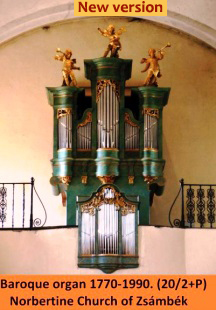
Baroque organ of Zsámbék (Hungary)

Baroque organ of Zsambek
                                                                                History

 Zsámbék is a small town near Budapest (Hungary), 5,000 inhabitants.

Norbertine monks built a monastery and a huge church in 1200. The church was destroyed by an earthquake in 1763. The ruins are still visible. Then the monks built a Baroque church The church's organ was built by unknown master in 1770. The organ had one manual with 10 stops. The organ was totally destroyed over time. The organ was rebuilt and expanded by Albert Miklós in 1999. The reconstruction was loaned by using the original pipes.

This was my first organ recording and sample, in 2013. I didn't have good microphones at the time, I made the recording with two handheld recorders, a Tascam dr05 and a Zoom H2n, but I only used the Tascam recording for the sample. And I had very little practice at that time. It's been 10 years since then and I've taken the original recording again and re-processed the raw sample. This is how the new version was made. This is much better quality than the original version and has 4-channel surround sound. But the recording itself is not new, and my old microphones limit the quality. So this sample is not up to the quality of my current samples, but it is much better than the original.
Many thanks to my friends (Gérard Lefranc, Dominique Dantand, István Nagy, Jean-Pierre Silvestre) for testing the sample and making the audio demos.
Features
Sample quality 
The sample sets are available in wave format 48kHz/24bit, stereo, multiple loops (1-4) and multiple releases (3 levels). Equal, a=440 Hz 

The sample sets made ​​in three versions, stereo near, stereo far and 4 channels surround

Hauptwerk v4.2 or v5-9 supported for the Organ Definition Files.

Keyboards, Pedal 
The original organ compass of the manuals are 54 keys (the virtual version:56 keys), the compass of the pedal is 30 keys (the virtual version 30 keys).   

RAM requirements (GB)

2-channels stereo

4-channels surround


16 bit

24 bit

16 bit

24 bit

Zsámbék sample set

4

6

8

10

The values given are for information only. They depend on the operating system and other utilities.
Specifications  

Original version

Extended version

Pedal  original: 30 keys, virtual: 32 keys

Subbass 16, Oktavbass 8', Gedactbass 8', Choralbass 4'

Fagott 16'   

Pedal  original: 30 keys, virtual: 30 keys


Great  original: 54 keys, virtual: 56 keys

Principal 8' , Gedackt 8', Oktave 4', Spitzfloete 4', Quint 2 2/3'

Superoktave 2', Terc 1 3/5', Mixtura 1 1/3'

Schalmey 8'

Great  original: 54 keys, virtual: 56 keys

+ Coppel 16', Schalmey 16'

Positiv original: 54 keys, virtual:56  keys

Coppel major 8', Coppel minor 4', Floete 2

Quint 1 1/3', Sedecima 1'

Regal 8'                            

Positiv original: 54 keys, virtual: 56 keys

+ Nasat 2 2/3', Vox Humana 8'

Couplers

P+I, P+II, I+II


Tremulant

I, II

Enclosure

-

Couplers

+ P super, II super

Tremulant


Enclosure

II

Expansions are only the organ own sound files    
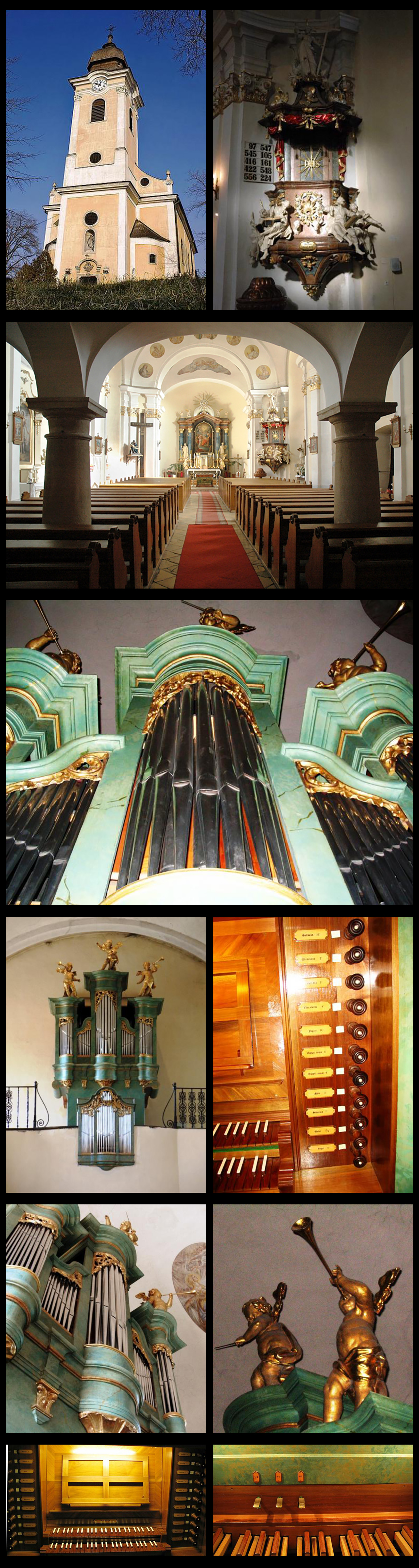
Pictures
Norbertine's Church of Zsambek and Baroque Organ
Audio demos

Playing Dominique Dantand, Nagy István and Jean-Pierre Silvestre
Download / Order
Try the the demo sample sets before you buy!
The Trial Versions of the Baroque organ from Zsambek has a limited compass of C2-C3 (048-c to 060-c) in the pedal, C2-G5 (048-c to 079-g) in the manuals. 
All other functions work. First install pack 01 and then pack 02. The order of installation is important. After installing the first pack, you can use the far version. If you then install the second pack, you have the option to use the near and 4-channel surround versions.

Buy the full Baroque organ from Zsambek sample set (You can pay in dollars or euros.)


39 EUR 
 46 USD 


Important notice
Those of my customers who bought the older version of the Zsámbéki pattern, please apply, because I will provide them with the renewed pattern for free. The new version received a new ID, so the old version does not need to be deleted, both versions can be used, but the personal settings are not inherited between the two versions.
You can apply and request the new version via the contact form.