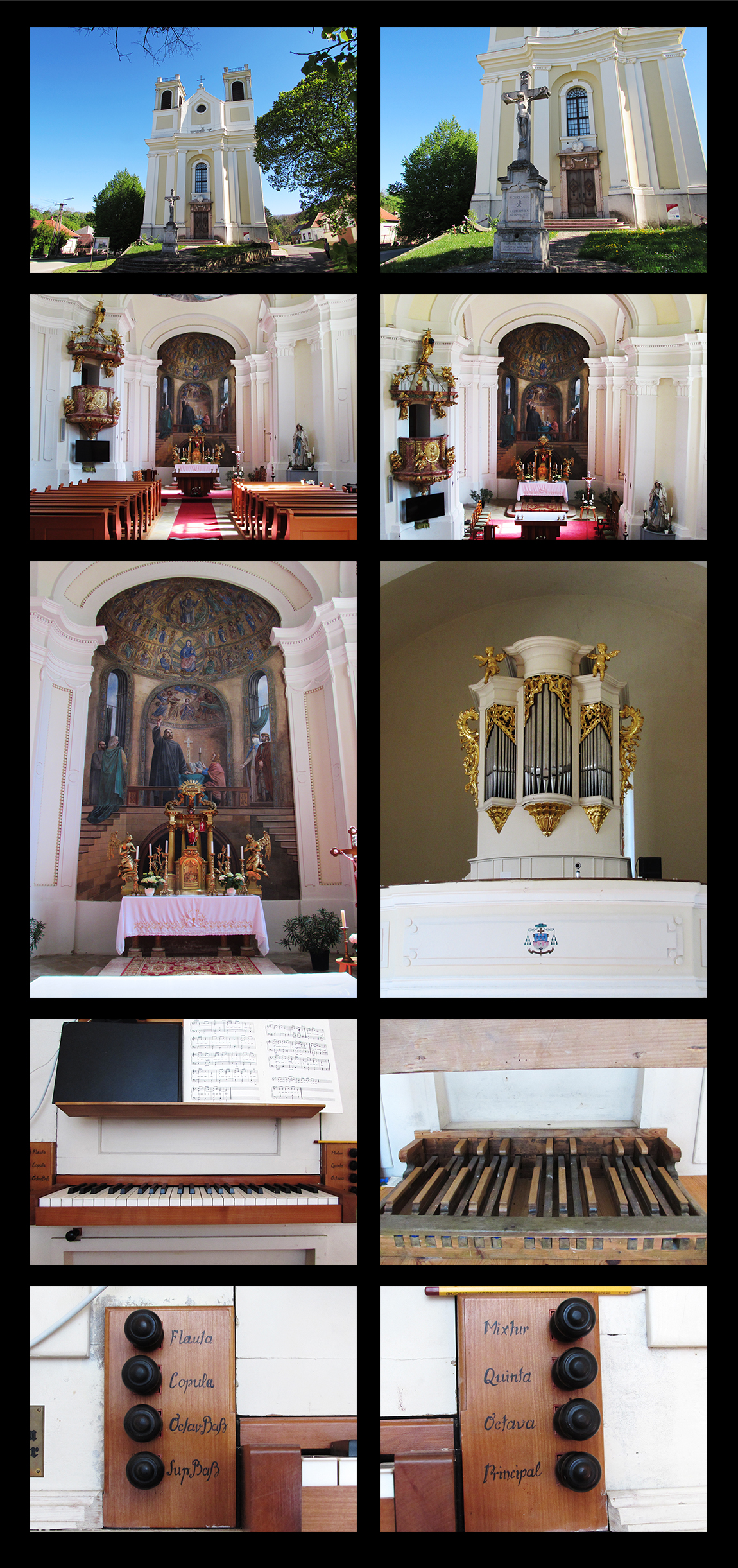
The organ of Peter Peking from the Catholic church in Veszprémvarsány (Hungary)
Országh organ of Szentbekkala
                                                                                History
Veszprémvarsány is a village on the eastern slope of the Bakony Mountains, in Transdanubia, Hungary. Its population is 1,000.

Varsány was already known in the 1200s, and was considered the most populous village of the Pannonhalma Abbey. The village was depopulated during the years of the Turkish occupation, and its church was also destroyed. The new church was built in 1774 in the Baroque style. The church's furnishings are in the Rococo and Zopf styles, while the main altar and pulpit are classicist.The church, with its excellent acoustics, is the largest church in the area.

The 6-stop organ was built in 1780 by Péter Peking. Péter Peking (1734-1788) from Győr was the greatest organ builder in Transdanubia. He mainly made organ positives, but a 2-manual, 17-stop organ of his is still in operation in the Carmelite Church in Győr. The Varsány organ was partially rebuilt by Károly Roland in 1869, and he made a pedal mechanism for the organ. Minor repairs were made in the following century, and the organ was restored by the Aquincum organ factory in 2001.

The following friends helped me to make and publish the sample set (in alphabetical order): Dominique Dantand, Gérard Lefranc, Nagy István and Jean-Pierre Silvestre If something's done well, it's thanks to them. Special thanks to organist István Nagy and cantor Martin Gönye, who helped me with permission to record and make samples.
Features
Sample quality 
The sample sets are available in wave format 48kHz/24bit, stereo, multiple loops (1-6) and multiple releases (3 levels). Equal, a=467 Hz 

The model is available in original and extended versions, and both versions can be installed in 2-channel rear and 2-channel near, as well as 6-channel surround versions.

By default you can use equal temperament, but the organ's own temperament is available, which corresponds to Werckmeister III.

Hauptwerk v4.2 or v5-9 supported for the Organ Definition Files.

Keyboards, Pedal 
The original and extended organ compass of the manuals are 51 keys  the compass of the pedal is 25 keys.  

RAM requirements (GB)

2 channels sztereo

6 channels surround


16 bit

24 bit

16 bit

24 bit

Varsany                                       

5 (3)

7 (4)

10 (6)

14 (8)

The values given are for information only. They depend on the operating system and other utilities.
Specifications  

Original specification

Extended extension

Pedal  25 keys

Octavbass 8’, Subbass 16’

Pedal  25 keys

+ Choralbass 4’ (from manual Principal)

Manual I. 51 keys

Flauta 4’, Copula 8’, Mixtura, Quinta (1 1/3’

Octava 2’, Principal 4’

Manual I. 51 keys

same

Manual II.

-

Manual II. 51 keys (Registers from the first manual.)

Flauta 4’, Copula 8’, Nasat 2 2/3’ (from Flauta)

Octav 2’, Terz 1 3/5’ (from Octav)

Flauta solo, Copula solo

Couplers

-

Couplers

-

Tremulant

I

Tremulant

I, II

-

Enclosure

II

Expansions are only the organ own sound files    
Pictures
The Catholic Church from Szantbekkala and the Orszagh Organ
Audio demos

Original version:

Playing Dominique Dantand and Nagy István

Extended version:
Playing Jean-Pierre Silvestre
Download / Order
Try the the demo sample sets before you buy!
The Trial Versions of the Veszpremvarsany (Varsany) organ has a limited compass of  C2-G5 (048-c to 079-g) in the manuals. The pedal and the second manual's registers (Nasat, Terz) made from other registers only partially work in the demo version. 
You have to download and install the demo install file and then you can use the near, far and surround versions, as well as the extended and original versions. The IR file can be installed and used by those with Hauptwerk v5-9 to echo the near (semidry) version.

Buy the full Varsany sample set (You can pay in dollars or euros, in several ways.)


40 EUR
cards
Powered by paypal
46 USD   
 
cards
Powered by paypal