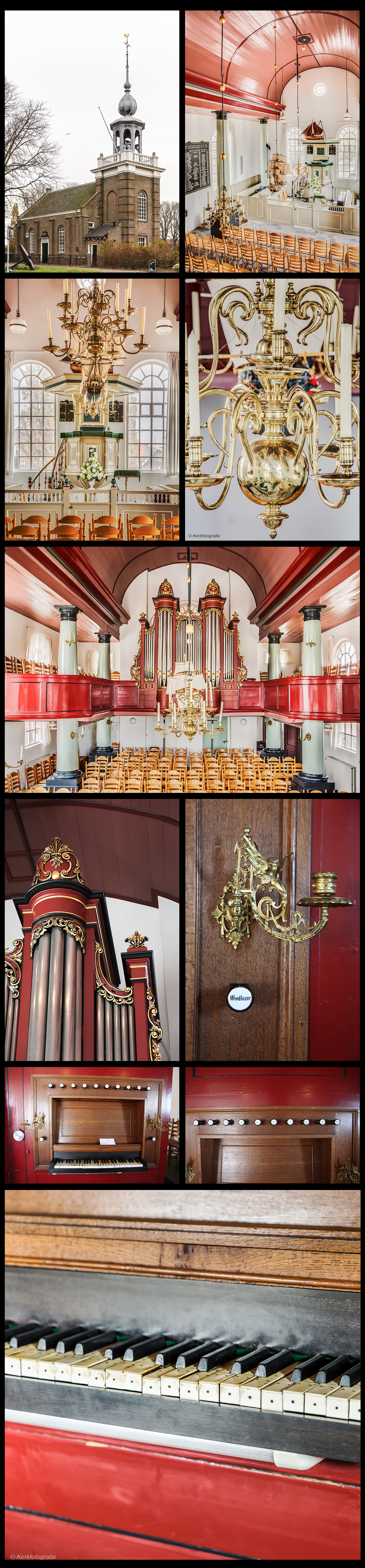
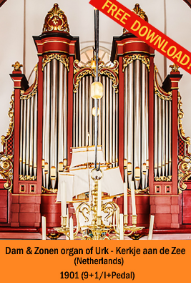
Dam & Zonen Organ from Urk - Kerkje aan de Zee (Netherlands)
Dam & Zonen Organ from Urk                                                                                                         History
In the Northern part of the Netherlands, lies the district: Flevoland. A Province which is not older than 85 years... In this province some older places can be found. Of which one is called 'Urk'
Urk is a place with roundabout 20.000 inhabitants, and is well-known for its abilities around Fishing, and Fish-processing. And for the main part (over 95%) of the inhabitants, to be 'christian'.

So because of the high percentage of christians, Urk has a lot of churches. In the older part of the village, a little church stands on top of the hill (which was the Island of Urk in earlier times). This church is the highest place of Urk, and the oldest church of Urk. Because of the congregation growing to big for the little church, this church is not in use anymore. Whereas a newer, bigger church has been built somewhere else in Urk.

The organ however remained in the little church. It was built by van-Dam & Zonen. A famous, dutch, (late-)romantic organ builder. Who was located in Fryslan, and also built the famous organ in the 'Grote kerk te Tholen' which has been sampled too. This organ (Urk) was originally built (in the 1901's) for the church in Munnekeburen (Netherlands) but has been moved to urk in the 20th Century by Klaas Kapitein. It has been restored and enlargened (with a since-the-building planned) 'Trompet 8'.
The organ suits perfect for accompanying congregations, but is also nice for playing the Suites of Bach, where no second manual is needed. In real the organ does have an attached pedal, but with the modern techniques, we made an extension on the pedal, so a Bourdon 16 and a coupler are present.<

Special thanks to Leander vd Bos for obtaining the license. He recorded with the help of Riekelt Bakker and Henk Pasterkamp. The following friends helped me to make and publish the sample set (in alphabetical order): Dominique Dantand, Gerard Lefranc, Nagy Istvan and Jean-Pierre Silvestre. If something's done well, it's thanks to them. Thank you for their work.
I am very hopeful that we will be able to continue our work with Leander and that we will be able to produce more Dutch organ samples soon.

Features
Sample quality 
The sample sets are available in wave format 48kHz/24bit, stereo, multiple loops (1-12) and multiple releases (3 levels). a=430 Hz
The sample sets are made in three forms

a. A version of far stereo

b. A version of near stereo

b. A Surround version (2 pairs of stereo recording: close (near); at distance (far).

In the surround version you can adjust the perspective by setting the volume of the near and far recordings. 

The sample set reverb is 1 s reflecting the original  acoustics of the church.  (HW 5-6 users can use IR reverb)

Hauptwerk v4.2 or v5-9 supported for the Organ Definition Files.

Keyboards, Pedal 
The original and virtual organ compass of the manuals are 56 keys, the compass of the pedal is 27 keys.

RAM requirements (GB)

2 channels sztereo

6 channels surround


16 bit

24 bit

16 bit

24 bit

Urk

3

4

6

8

The data is for information only. They depend on the operating system and other apps.
Specifications  

Pedal  (27 keys) – 1 extended stop

Bourdon 16’ (From Farkasret-Budapest – Hungary)

I. Hauptwerk (56 keys) – 9 stops

Prestant 8’, Bourdon 16’ (discant),  Violincello 8’, Holpijp 8’

Octaaf 4’, Octaaf 2’, Fluit d’amour 4’, Cornet 3st

Trompet 8’ (Discant and Bas)

Coupler

I/P

Tremulant

I

Pictures
Urk - Kerkje aan de Zee and the Organ of Church


Audio demos

Playing Dominique Dantand, Nagy István and Jean-Pierre Silvestre
(The first and fifth and sixth audio demos are made with Hauptwerk v4.2 and showcase native sound. 
The other audio demos were made with Hauptwerk 6 and an added IR reverb.)
Introducing the options of the sample set

Playing Paul Fey
Free download the full sample set!
and install the sample that can be used with Hauptwerk v4.2 or Hauptverk 5-6.  Install the 01 pack first. After installation, you can use the stereo-far version. Then install pack 02. After installation, you can also use the stereo-near and 4-channel surround versions. The order of installation is important, you can't deviate from it!
After installation, you can use the full sample without any restrictions.  If you like the sample, upload audio demos to contrebombarde.com. 


Surround vs Stereo mode

If you do not have a surround sound system, but there is enough memory (RAM), I suggest you also install the surround version. If you activate the front and rear stops too, then you will get a more compact and fuller sound than the simple stereo.

Guide: simple stereo from surround, how to?