
Gonda-Erdősi  Organ from Assumption Parish Church in Polgár (Hungary)
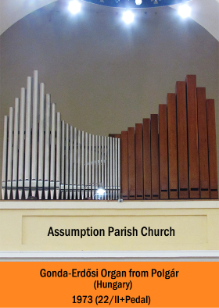
Gonda-Erdosi Organ from Polgar (Hungary)
                                                                                             History
Polgár is a small lowland town with 8,000 inhabitants in Eastern Hungary, Hajdú-Bihar county.
Polgár was already an inhabited settlement in prehistoric times. The settlement had its heyday in the 1600s, when it was an independent and privileged city, mainly thanks to its military. After that, its importance declined, and it is still only one of many small towns whose population lives mainly from agriculture. The town already had a church in the Árpád era, which was destroyed by the Tatar invasion of 1240. The town's population became Calvinist during the Reformation, so there was no Catholic church in the town at the beginning of the 1700s. Thanks to the changes in the religious proportion of the population, the Catholic church was built in 1748. After 100 years, this church proved to be very cramped, it was demolished, and based on the plans of the famous Hungarian architect József Hild, a huge classicist style church was built, which was completed in 1858.

The church's first organ was built by Ludwig Mooser (Mooser organs are also in the Esztergom and Eger basilicas), it was a two-maual organ with 31 registers, but it was completely destroyed in the Second World War. The church remained without an organ for decades, because the communist era did not favor the construction of an organ.

Finally, in the 1970s, the organ of the church was built against the communist rulers with donations from the church and the faithful. The construction of an organ was an almost impossible task at that time, the goal was to use the scarce financial resources available to build an organ that would fill the huge church with its sound, and would also be suitable for concerts in addition to liturgical purposes. This almost impossible mission was accomplished by the duo Nándor Gonda - József Erdősi. Nándor Gonda soon realized that it was impossible to build a large organ with the available money. That is why, abandoning traditional plans, he designed a completely original organ based on the results of the German avant-garde movement, which, thanks to its special mixed registers and intonation, became suitable for fulfilling the stated goals. József Erdősi accepted the plans in disbelief, and then with increasing enthusiasm, he built this fantastic organ almost from materials that had been thrown away. This organ can be truly appreciated by those who lived through the communist times. This organ is proof of the desire to create, enthusiasm and faith. You can read a detailed and professional description of the organ here. I recommend reading this to all organists, it is a very exciting study. This organ is almost unknown even to Hungarian organ fans, even the local parish priest does not know what a valuable instrument their parish owns. 

The following friends helped me to make and publish the sample set (in alphabetical order): Dominique Dantand, Gérard Lefranc, Nagy István and Jean-Pierre Silvestre. If something's done well, it's thanks to them. Thank you for their work.  I owe special thanks to the organists István Nagy and András Dékány, thanks to their intercession I was able to record and prepare the organ sample.

Features
Sample quality 
The sample sets are available in wave format 48kHz/24bit, stereo, multiple loops (1-12) and multiple releases (3 levels). a=434 Hz
The sample sets are made in three forms

a. A version of wet stereo (far)

b. A verion of semidry stereo (near)

c. A Surround version (3 pairs of stereo recording: near,  front and in the background.

In the surround version you can adjust the perspective by setting the volume of the near, far and rear recordings. (Suitable HW loading and channel settings can be used to give wet or semidry stereo modes or 4 channel surround mode too).   

The sample set reverb is 4.5 - 5 s reflecting the original  acoustics of the church.  

Hauptwerk v4.2 or v5-v9 supported for the Organ Definition Files.

Keyboards, Pedal 
The original organ compass of the manuals are 58 keys, the compass of the pedal is 30 keys.
Operating Instructions:

RAM requirements (GB)

2 channels sztereo

6 channels surround


16 bit

24 bit

16 bit

24 bit

Polgar

5

7

12

16

The data is for information only. They depend on the operating system and other apps.
Specifications  

Pedal  (30 keys) – 6 stops

Nachthorn 16’, Flötenprincipal 8’, Gedacktbass 8’, Rohr-nasat 5 1/3’, Choralpfeiffe 4+2’, Harmonie 5x


I. Hauptwerk (58 keys) – 7 stops

Principal 8’, Lieblich Gedackt 8’, Oktava 4’, Konzertflote 4’, Gems-nasat 2 2/3’, Kleine Principal 2+1’, Quintanona 3x

II. Schwell (58 keys) – 9stops

Doppelgedackt 8’, Spitzgamba 8’, Eol-harp 8+8Principal 4’, Rohrflöte 4’, Blockflöte 2’, Sonus dulcis 4x, Klingelcimbel 4x

English-horn 8’ (from Brasow, Wegenstein organ)

Couplers

original: P+I, P+II, P+II super, I+II sub, I+II, I+II super, I super,

extension: P+I super

Tremulant

I, II

Enclosure

II

Pictures
Assumption Parish Church in Polgar and Gonda-Erdosi Organ

Audio demos

Playing Dominique Dantand, Nagy István, and Jean-Pierre Silvestre
Download / Order
Try the the demo sample sets before you buy!
The Trial Versions of the Polgar Organ  has a limited compass of C2-C3 (048-c to 060-c) in the pedal, C2-G5 (048-c to 079-g) in the manuals. All other functions work. 


(First install the pack01 file. After installation, you can use the stereo-far version. Then install the pack02 file. After installation, you can use the stereo-near version. Finally, install the pack03 file. After that, you can use the 6-channel surround version. The order of installation is important, you cannot deviate from it!!) 

The IR file should only be downloaded and installed by anyone using Hauptwerk version 5 or 6 or 7. It is optimized for the stereo near version.


Surround vs Stereo mode

If you do not have a surround sound system, but there is enough memory (RAM), I suggest you also install the surround version. If you activate the front and rear stops too, then you will get a more compact and fuller sound than the simple stereo.

Guide: simple stereo from surround, how to?  

Buy the full (stereo and surround) Polgár Organ sample set (You can pay in dollars or euros.)


60 EUR 
65 USD
