
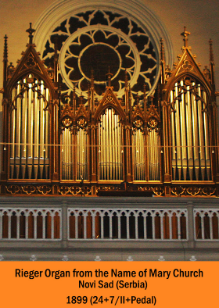
Rieger Organ of the Name of Mary Church from Novi Sad (Serbia)

Rieger Organ from Novi Sad
                                                                                             History
Novi Sad (Hungarian: Újvidékis the second largest city in Serbiaa and the capital of the autonomous province of Vojvodina. 
The population is 341.000.
Novi Sad is today the most important industrial city in Serbia. In ancient times, this city belonged to the Kingdom of Hungary. Many of the city’s old buildings, including the huge Catholic church in the city center, commemorate this period.

The local Catholic parish was organized in 1702, and the original church was built in 1719 on the same location as today's church. This original church was destroyed in 1742. The second church, was heavily damaged in the bombing during the Hungarian Revolution of 1848 and its bell-tower was destroyed. It was later partially reconstructed. In 1891, the city council made a decision to demolish the old church, and to build a new one on the same location. Hungarian architect György Molnár designed the church in 1892 for free. The main construction was finished in November 1893. The 72-meters high bell-tower with the golden cross was finished in October 1894.

The Rieger brothers built the church organ in 1899. The Op. 486 organ has a romantic disposition, 2 manual and pedal, 24 register, mechanical keyway, conical valve control. There were only minor repairs to the organ, it is still functional and has fully retained its original disposition and pipes. Hungary's similar Rieger organs have unfortunately fallen victim to the modernizing, baroque aspirations of the 1960s, but this organ has retained its original romantic beauty and uniqueness.

Special thanks to my friend Pecze Andor, who arranged for the organ to be recorded. The following friends helped me to make and publish the sample set (in alphabetical order): Dominique Dantand, Gérard Lefranc, Nagy István, Pecze Andor and Jean-Pierre Silvestre. If something's done well, it's thanks to them. Thank you for their work. 
This is where I want to commemorate two of my late friends, Adrian Wheal and Alain Grandchamp. They helped me a lot in sample making and testing for many years. I recommend this sample set in their memory.

Features
Sample quality 
The sample sets are available in wave format 48kHz/24bit, stereo, multiple loops (1-12) and multiple releases (3 levels). a=438 Hz
The sample sets are made in three forms

a. A version of wet stereo (far)

b. A version of semidry stereo (near)

b. A Surround version (3 pairs of stereo recording: close (near); at distance (far) and in the background (rear).

In the surround version you can adjust the perspective by setting the volume of the near, far and rear recordings. (Suitable HW loading and channel settings can be used to give wet or semidry stereo modes or 4 channel surround mode too).   

The sample set reverb is 3.5-4 s reflecting the original  acoustics of the church.  (Created IR file for HW5-6 users)

Hauptwerk v4.2 or v5-9 supported for the Organ Definition Files.

Keyboards, Pedal 
The original organ compass of the manuals are 54 (expanded 56) keys, the compass of the pedal is 27 (expanded 30) keys.
Operating Instructions:

RAM requirements (GB)

2 channels sztereo

6 channels surround


16 bit

24 bit

16 bit

24 bit

Novi Sad

6

8

14

18

The data is for information only. They depend on the operating system and other apps.
Specifications  

Original specification

Extended extension

Pedal  27 keys

Subbass 16’, Violon 16’, Octavbass 8’, Cello 8’

Puzon 16’

Pedal  30 keys

+ Grossquint 10 2/3’ (from I. Bourdon 16’)

+ Bassfloete 8’ ( from I. Hohlfloete 8’)

+ Principal 16’ (from Savaria sample)

+ Trompette 8’ =From I. manual)

+ Mixtura (from I. Cornett, II. Harm. Aeth.)

Manual I. 54 keys

Principale 8’, Bourdon 16’, Gedeckt 8’ Gamba 8’,

Hohlfloete 8’, Gemshorn 4’, Octava 4’, Octava 2’

Cornett 3-4f, Mixtura 5f, Trompette 8’

Manual I. 56 keys

same

Manual II. 54 keys

Violin Principale 8', Aeolina 8', Salicional 8’,

Lieblich Gedeckt 8’, Dolce 4’, Flauto 4’

Harmonia aetheria 3f, Fagott oboae 8’

Manual II. 56 keys

+ Vox Celestis ( from II. Aeolina 8’)

+ Fagott 16 (From Puzon 16’, Fagott 8’)

Couplers

I/P, II/P, II/I

Couplers

+ P4, I/P4, II/P4, I4, II4, II/I16, II/I4

Tremulant

-

Tremulant

+ II

Enclosure

-

Enclosure

+ II

Pictures
Name of Mary Church from Novi Sad and Rieger Organ

Audio demos

Playing Dominique Dantand, Nagy István, Pecze Andor and Jean-Pierre Silvestre
Download / Order
Try the the demo sample sets before you buy!
The Trial Versions of the Novi Sad Organ has a limited compass of C2-C3 (048-c to 060-c) in the pedal, C2-G5 (048-c to 079-g) in the manuals. All other functions work. 

(Install the part01 of the stereo-wet version. Install the part01 and then the part02 and part03 of surround version. It is important to sort.) 

The IR file should only be downloaded and installed by anyone using Hauptwerk version 5 or 6. It is optimized for the stereo near version.


Surround vs Stereo mode

If you do not have a surround sound system, but there is enough memory (RAM), I suggest you also install the surround version. If you activate the front and rear stops too, then you will get a more compact and fuller sound than the simple stereo.

Guide: simple stereo from surround, how to?  

Buy the full (stereo and surround) Novi Sad sample set (You can pay in dollars or euros.)


65 EUR   
73 USD