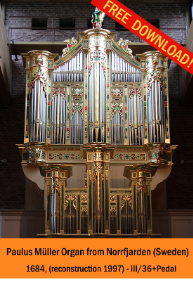
The instrument in Norrfjärden church is a modern replica of the organ that was built in the
seventeenth century for the German church in Stockholm, by the organ builder Paulus Müller. The history of this organ started in 1609, when the parish council commissioned Müller an
instrument with 21 stops and pedal. From 1638 to 1641 the German church was reconstructed and enlarged, and in 1647/1651 the organ was also expanded to a three-manual, 35 stop instrument, work done by George Herman. From the 1690s, the organ began to become obsolete. There were several attempts to maintain it but in 1748 the organ builder Olof
Hedlund refused to make any further repairs and so in 1777 the organ was taken down and two
years later sold to the parish of Övertorneå, close to the Finnish border. The organ was carried
on barges to the north of Sweden and in 1780 the Hauptwerck and Oberwerck were erected in
Övertorneå church. Soon the instrument had to be adapted to the necessities of the church in
Övertorneå, and therefore the organ was retuned to a more equal temperament by Matthias
Swahlberg. The sub‐semitones D sharp/E flat were removed. A new case was also built to
accommodate the lower ceiling in Övertorneå. The Rückpositiv became an organ for its own, in
the nearby parish of Hietaniemi. The pedal seems to have disappeared entirely. In 1934 the
Övertorneå organ was taken out of use and a new organ was built behind the old façade. In
1969‐71 the old organ was put back into working order, this time by Grönlunds orgelbyggeri.
The latest restoration was done in 1997‐9 returning the instrument to its original state of 1780.
The pedal has been newly built, according to research, following the aesthetic and construction
principles of the early times. The organ in Norrfjärden was built by Grönlunds orgelbyggeri
between 1993‐97.
The idea behind the project started in 1989, when Hans‐Ola Ericsson, installed at the time as
professor at the School of Music in Piteå, submitted to the county governor a number of
projects which would stimulate cultural activity in Norrbotten. The project proposal was divided
into three parts: the first suggested a scientific documentation of the 17th century organ in
Övertorneå, and the preserved 17th century material in Hedenäset; the second part was the
reconstruction of the organ, of its 17th century appearance and sound from its sojourn in the
German church in Stockholm, placed in the church in Norrfjärden, outside Piteå; the third
proposal was the restoration of the organ in Övertorneå. The total budget for the project was 9
million Swedish krona.
The organ is tuned in meantone temperament, at a pitch of approximately a’= 467 Hz. It has a
short octave in the bass where also F sharp and G sharp can be played on the raised back half of
manual split keys. All the manuals and pedal have the subsemitone E flat/D sharp in every
octave. Another identical copy was made and it is now placed back home, in the German church
in Stockholm.
The organ was recorded by Lars Palo in 2011. He also created the sound sample in grandorgue format, which He released in 2023. The GO sound sample can be freely downloaded from Lars Palo's website. At the suggestion of my French organist friend, Dominique Dantand, and with the permission of Lars Palo, I created the Hauptwerk format of the sample. The following friends helped me to make and publish the sample set (in alphabetical order): Dominique Dantand, Gerard Lefranc, Nagy Istvan and Jean-Pierre Silvestre. If something's done well, it's thanks to them. Thank you for their work.