

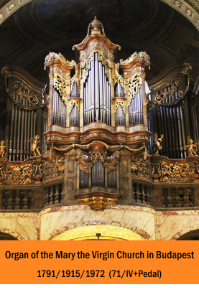
The Church of the St Mary the Virgin (University Church) is located in the city center.
The church was built by the only Hungarian-founded order, the Order of St Paul the First Hermit, on the site of a demolished mosque in 1723. The architect was András Mayerhoffer, who was one of the outstanding figures of Hungarian Baroque architecture. The church was built for a very long time and was not completed until 1771. This church was the central church of the Paulines. After the Pauline Order was dissolved in 1786, the church became the property of Pázmány Péter University. Since the church is still owned by the university, the common language is known as the University Church.
The first organ of the church was completed in 1791. It was a two-manuals organ. Unfortunately, in 100 years, this organ has been completely destroyed and its disposition has not survived. Only the organ cabinet remained.
The new organ was built by the Rieger organ factory in Budapest from 1910 to 1915. This organ had 3 manual, 57 stops, pneumatic systems. The disposition of the organ was designed by Aladár Zalánffy, and the neo-baroque organ cabinet was made by Ernő Foerk.In 1942-43 the disposition of the organ was changed to a lesser extent, based on the plans of Ferenc Gergely.
Between 1970 and 1972, the organ was significantly expanded according to the plans of Ferenc Gergely, István Koloss, László Bucsi and László Fehér. The original baroque organ cabinet, which had been empty until then, was incorporated and this became the Brust-positive work (fourth manual). The organ was expanded to 71 stops and the pneumatic system was partially replaced by an electric tractura. This work was carried out by the Organ-building of the Metropolitan Craft Company, which was the successor to the Rieger.
The Pécs Organ Manufactura (POM) carried out the general repair and cleaning of the organ in 2003, when the Tompete 8 'register, which was missing from the pedal, was installed.
The organist László Gesztesi-Tóth obtained the permission to record the organ, and he deals with the distribution of the sample in Hungary.
The processing of the recording was made very difficult by the fluttering noise generated by the electromagnets. I got good ideas from Samuel Sleath and Fred de Jong to remove this noise. Without their help, nothing would have been out of this sample.
The following friends helped me to make and publish the sample set (in alphabetical order): Dominique Dantand, Gérard Lefranc, Nagy István and Jean-Pierre Silvestre. If something's done well, it's thanks to them. Thank you for their work.
The sample was prepared in 2-channel stereo front-near, 2-channel stereo front-far, and 6-channel (near-far-rear) surround versions.
The reverb is 4.5 s, reflects he original acoustics of the church.
Hauptwerk v4.2 or v5-8 supported for the Organ Definition Files.
|
RAM requirements (GB) |
2 channels sztereo |
6 channels surround |
||
|
|
16 bit |
24 bit |
16 bit |
24 bit |
|
Mary the Virgin, Budapest |
9 |
14 |
20 |
32 |
|
Pedal (original and virtual 32 keys) – 17 stops Bourdon 32’ Prinzipalbass 16', Violinbass 16’ Subbas 16' Grossquint 10 2/3’, Oktavbass 8', Cello 8’, Pommer 8’ Gedacktquint 5 1/3’, Choralpfeife 4’, Nachthorn 2' Hintersatz 5 1/3' 5f, Mixtur 2' 4f, Kontrafagott 32’ Pousane 16' Trompete 8', Clairon 4’ |
|
I. Positivwerk (original and virtual 61 keys) – 11 stops Gedackt 8’, Quintadena 8’, Gemshorn 4’, Hohfloete 4’ Nasat 2 2/3’, Oktav 2’, Terz 1 3/5’, Scharff 1 1/3’ 4f Rankett 16’, Krummhorn 8’ Celesta 4’ |
|
II. Hauptwerk (original and virtual 61 keys) – 16 stops Prinzipal 16', Gedackt 16’, Prinzipal 8’, Querfloete 8’, Gemshorn 8’ Salizional 8’, Oktav 4’, Rohrfloete 4’, Quint 2 2/3’, Superoktav 2’ Kornett 2 2/3’ 3-4f, Mixtur 2’ 5f, Mixtur 1’ 3f Fagott 16’, Trompete 8’, Helle Trompete 4’ |
|
III. Schwellwerk (original and virtual 61 keys) – 20 stops Stillgedackt 16’, Hornprinzipal 8’, Konzertfloete 8’, Gamba 8’ Vox celestis 8’, Pommer 8’, Oktav 4’, Waldfloete 4’ Gemsnasat 2 2/3’, Kleinoktav 2’, Spitzfloete 2’, Terz 1 3/5’ Oberton 1 1/7’+8/9’ 2f, Mixtur 1 1/3’ 4f, Terz-zimbel 2/5’ 3f Sordun 16’, Franzözische-trompete 8’, Schalmey-oboe 8’ Vox Humana 8’, Rohrschalmey 4’ |
|
IV. Brust-Positivwerk (original and virtual 61 keys) – 7 stops Floetgedackt 8’, Prinzipal 4’, Blockfloete 2’, Superquint 1 1/3’ Siffloete 1’, Quint-zimbel ½’ 3f Knopfregal 8’ |
|
Couplers original: I/Ped, II/Ped, III/Ped, IV/Ped, I/Ped super, III/Ped super III/I, IV/I, I/II, III/II, IV/II, III/II sub, III/II super, IV/III virtual extension: II/Ped super, I sub, I super, III/I sub, III/I super IV/I super, I/II sub, I/II super, III. sub, III. super, IV sub, IV super Tremulant Original: I, III, IV virtual: + II Enclosure original: III virtual: + IV |
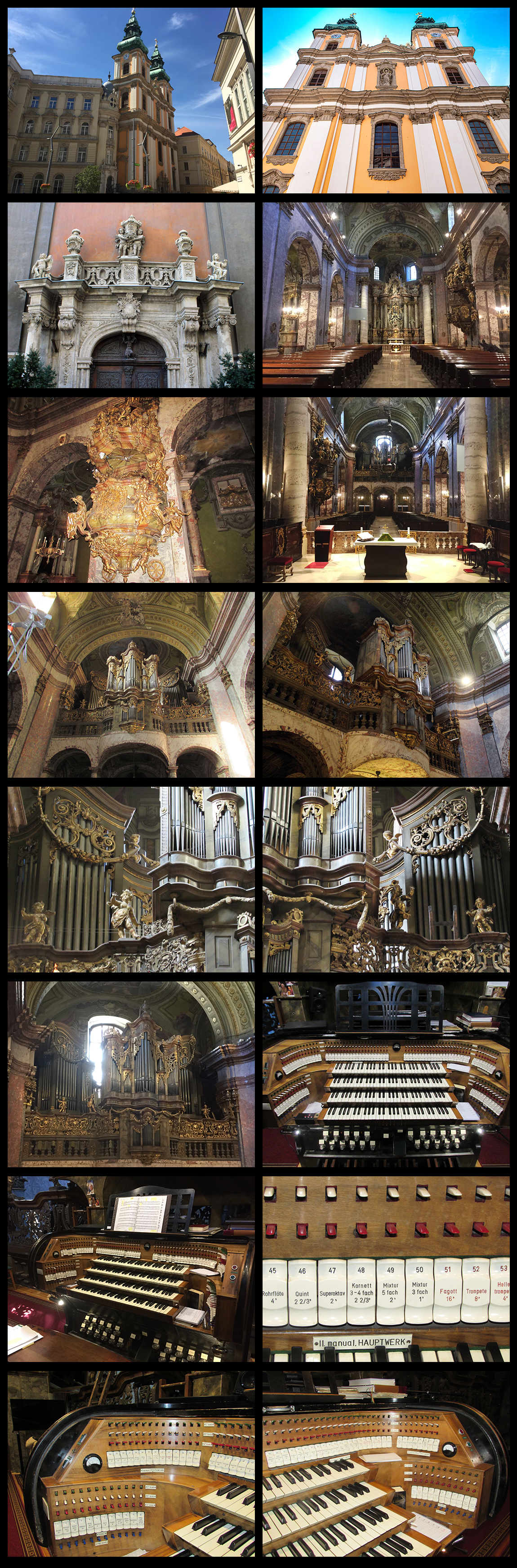
Free download the Hauptwerk demo sample sets:
Mary the Virgin in Budapest demo version
Install the package01 then the package02 finally the package03. It is important to sort.
After installing the first pack, you can use the stereo-far demo version. After installing the second pack, you can use the stereo-near version. Finally, after installing the third pack, you can use the 6-channel surround version.
Buy the full the Mary the Virgin in Budapest sample set (You can pay in dollars or euros.)