

Organ from Notre Dame Church of Lorris

History
Lorris is located 130 km south of Paris and 60 km from Orleans. A royal city since the 12th century, the kings of France had their residence there: the Château des Salles.
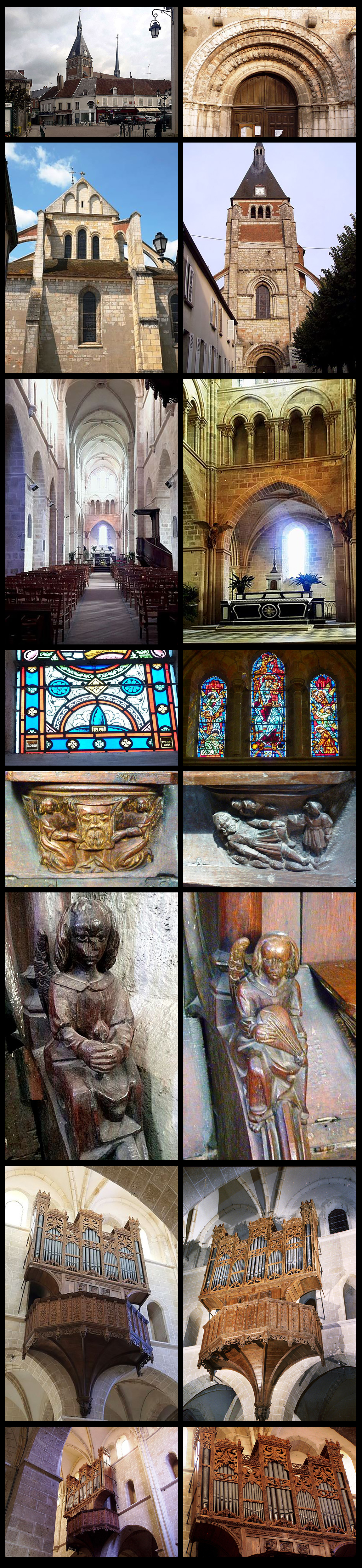
The Romanesque church dates from the 12th and 13th centuries. It was built under the monks of Saint-Benoît. It has been modified and expanded over the centuries. Saint Louis placed it under the protection of Notre-Dame. In 1562 the church was looted and significantly damaged, but the organ and the statue of the Holy Virgin were spared. The church was restored in 1607.
According to research, the organ was built in 1501, although no archival data has survived. The originally Renaissance organ was rebuilt several times in the following century. The organ was majorly repaired in 1681 and detailed documentation has already been prepared. According to this, the organ had a Baroque disposition and a Venetian style. The organ was constantly maintained and functioned well until the end of the 19th century. Then a jealous organist destroyed the organ by piercing the organ tubes. The organ was not repaired, but the pipes were tossed into the attic of the church, but the mechanics of the organ remained relatively intact. After a dream of almost a hundred years, the organ was restored from 1972 to 1974, and the organ once again became the adornment of the church as the oldest organ in France.
My French friends (Dominique and Gérard) found a 2006 Grandorgue sample of this organ on an old winchester. Unfortunately, it is not possible to know who made this GO sample set. I was asked to make a Hauptwerk version of this sample. I made this. I tried to improve the GO sample, but you need to know that this sample set falls short of the usual quality of Hauptwerk samples. The original sample is very dry, so I made a slightly echoed version as well, but in Hauptwerk versions 5 and 6 it is recommended to add IR. The sample can also be used with Hauptwerk 4.2 free version.
The following friends helped me to make and publish the sample set (in alphabetical order): Dominique Dantand, Gérard Lefranc and István Nagy. If something's done well, it's thanks to them. Thank you for their work.
Features
Sample quality
The recording and the Grandorgue format sample were made mono format, contains 1 loop and there is no separate release. The HW sample sets are available in wave format 44.1kHz/16 bit, mono, multiple loops (1-8) and multiple releases (2 levels). Equal, a=411 Hz and the authentical temperament file is attached.
The sample sets made in original dry and arteficial wet mono form.
Hauptwerk v4.2 and v5-9 supported for the Organ Definition Files.
Keyboards, Pedal
The original and virtual organ compass of the manuals are 49 keys, the compass of the pedal is 19 keys.
|
RAM requirements (GB) |
original |
|
Lorris |
16 bit |
|
dry, wet (one channels, mono) |
1 GB |
|
dry and wet (two channels, mono) |
2 GB |
The data is for information only. They depend on the operating system and other apps.
Specifications
|
Lorris sample set |
|
Pedal 19 key Suspended pedal with manual coupler switched on.
|
|
Manual 49 keys Montre 8’, Bourdon 8’, Prestant 4’, Nazard 2 2/3’, Doublette 2’ Tierce 1 3/5’, Larigot 1 1/3’, Plein Jeu, Cornet 8’ (disc.), Trompete 8’ (bass and disc.), Voix Humaine 8’(bass and disc.)
|
|
Couplers: I/P (always on)
Tremulant: manual
Slider of Dry-Wet-Noise volumen control |
Pictures
Audio demos
Playing Dominique Dantand and Nagy István
Free download the full sample set!
and install the sample that can be used with Hauptwerk v4.2 or Hauptverk 5-6.
After installation, you can use the full sample without any restrictions.
You can use this with equal temperament or with the Lorris temperament.
If you like the sample, upload audio demos to contrebombarde.com.
Jack H Smit indicated to me that the organ info file mistakenly contains not the Lorris but the Solignac organ.
He sent me a wonderfully edited organ info. I thank you very much for his work.
I created a patch file. If you download and install this, you too can enjoy Jack’s nice work.