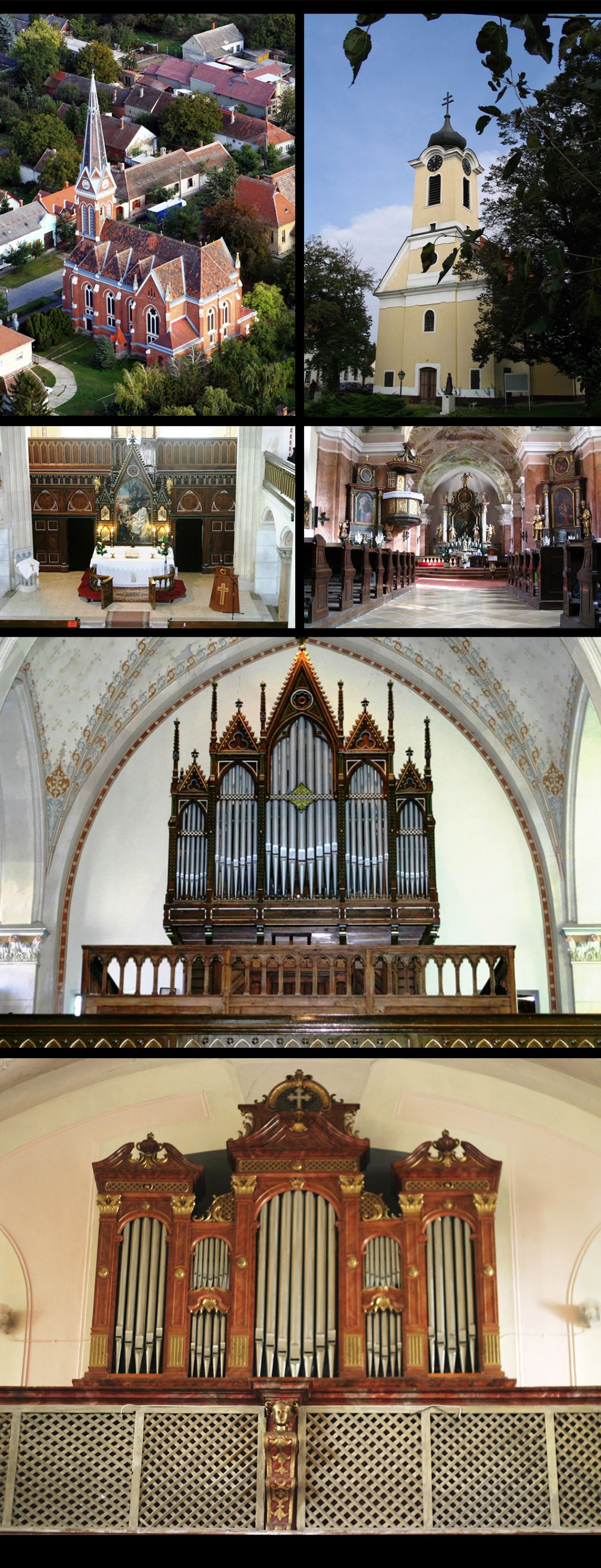
Angster  Organ composite from Lutheran Church and Catholic Church in Körmend (Hungary)
Angster Organs from Kormend
                                                                                             History
Kormend is a city in Western Hungary in Vas County. It is a market town with a population of 11,000.

The city was already inhabited in the Middle Ages. The city is famous because the famous ophthalmologist László Batthyany-Strattmann (1870-1931lived here, who treated poor patients for free in his hospital, and the Catholic Church recently beatified him.

More than 60% of the population is Catholic, and only 4% is Lutheran. St. Elizabeth parish church was built in the XV. century in late-Gothic style. The church was rebuilt in 1730 in Baroque style. The Lutheran church was built in 1888 in neo-Gothic style.

The organ of the Lutheran church was built by József Angster in 1893. This is a very beautiful, small, two-manual, 17-register mechanical organ with a romantic layout, which with its original layout has weathered the storms of history, and was restored by Albert Miklós in 1995 based on the designs of Gábor Lehotka.
The organ of the Catholic church was also built by József Angster, but 17 years later, in 1910. It is a pneumatic organ with two manuals and 23 registers. This organ went through many vicissitudes, it was rebuilt several times and baroqueized according to the taste of the time. The organ is currently in good condition, but not authentic.

I made sound samples for both organs in 2015 and these samples were part of my collection until recently. Because these small organs were primarily built for liturgical purposes, they are therefore less suitable for organ concerts. In the 2023 offseason, I reprocessed the 2015 raw recording, starting from the basics. I have improved my processing technique a lot in 9 years, so I expected the new version to be more beautiful and better than the previous one. While working, I came up with the idea that the sounds of the two organs could be combined. The unification was possible because the organs were built by the same master, and the acoustics of the two churches are similar. Since the disposition of the two organs differed significantly, after the merger a composite was created which, in addition to the liturgical service, is also suitable for playing ropmantic and baroque organ works. These two organs were the property of two competing parishes, but now the atmosphere has become fraternal. My hope is that this composite also serves ecumenism, the aspiration that Christians stick together, because they have one shepherd: Jesus Christ.

I have discontinued the distribution of the two old organ samples, instead of them here is the newly completed composite.

The following friends helped me to make and publish the sample set (in alphabetical order): Dominique Dantand, Gérard Lefranc, Nagy István and Jean-Pierre Silvestre. If something's done well, it's thanks to them. Thank you for their work. My friend cantor Dezső Papp, who was born in Körmend and served for a long time in the Catholic church in Körmend, helped me with the recording of the organs. I hope that he will also like the new arrangement.

Features
Sample quality 
The sample sets are available in wave format 48kHz/24bit, stereo, multiple loops (1-12) and multiple releases (3 levels). a=440 Hz
The sample sets are made in three forms

a. A version of wet stereo (far)

b. A version of semidry stereo (near)

c. A Surround version (3 pairs of stereo recording: near,  front and in the background.

In the surround version you can adjust the perspective by setting the volume of the near, far and rear recordings. (Suitable HW loading and channel settings can be used to give wet or semidry stereo modes or 4 channel surround mode too).   

The sample set reverb is 2.5-2.9 s reflecting the original  acoustics of the church.  

Hauptwerk v4.2 or v5-v9 supported for the Organ Definition Files.

Keyboards, Pedal 
The original organ compass of the manuals are 58 keys, the compass of the pedal is 30 keys.
Operating Instructions:

RAM requirements (GB)

2 channels sztereo

6 channels surround


16 bit

24 bit

16 bit

24 bit

Angster composite from Kormend

8

12

17

22

The data is for information only. They depend on the operating system and other apps.
Specifications  

Pedal  30 keys – 11 Stops

Subbass 16', Subbass 16’*, Bassquint 10 2/3’,

Principalbass 8', Apertbass 8’*, Oktavbass 8’*, Cello 8’*

Choralbass 4’, Fagott 16’, Trompete 8’*, Schalmey 4’

I. Manual (Positive) 58 keys – 9 Stops

Principal 8’, Bourdon 8’*, Oktav 4’*, Flauta 4’*,

Flachfloete 2’, Larigot 1 1/3’,  Siffloete 1’, Zimbel 1 1/3’*

Trompete 8’*

II. Manual (Great) 58 keys – 11 Stops

Bourdon 16’, Principal 8’*, Rohrfloete 8’, Gamba 8’,

Oktav 4’, Travers floete 4’, Quint 2 2/3’, Oktav 2’,

Terz 1 3/5’, Mixtura 4f

Trompete 8’

III. Manual  (Swell) 58 keys – 14 Stops

Bourdon 16’*, Geigenprincipal 8’, Floete Harmonique, 8’,

Salicional 8’*, Vox celestis 8’, Silvetrina 8’*, Flauta tibia 8’*

Gemshorn 4’, Flauta travers 4’*, Nasat 2 2/3’*, Flachfloete 2’

Mixtura 3f*

Fagott-Oboe 16’, Schalmey 8’

Couplers

GR/P8, GR/P4, SW/P8, SW/P4, Pos/P8, Ped4

GR/Pos16, GR/Pos8, GR/Pos4, SW/Pos16, SWE/Pos8, Pos4

Pos/Gr8, Pos/Gr4, SW/GR16, Sw/Gr8, Gr4

SW16, SW4

Tremulant

I, II, III

Enclosure

I, III

(* The stops are from Angster of Lutheran church in Kormend)

The virtual model provides a wide range of setup-registration options, including split jambs in horizontal and vertical orientations.

Pictures
The Catholic and the Reformed Church of Kormend, and Angster Organs

Audio demos

Playing Dominique Dantand, Nagy István, Jean-Pierre Silvestre
Download / Order
Try the the demo sample sets before you buy!
The Trial Versions of the Angster Organ composite form Kormend has a limited compass of C2-C3 (048-c to 060-c) in the pedal, C2-G5 (048-c to 079-g) in the manuals. All other functions work. 


(First install the pack01 file. After installation, you can use the stereo-far version. Then install the pack02 file. After installation, you can use the stereo-near version. Finally, install the pack03 file. After that, you can use the 6-channel surround version. The order of installation is important, you cannot deviate from it!!) 

The IR file should only be downloaded and installed by anyone using Hauptwerk version 5-8. It is optimized for the stereo near version.

(Attention! Extensions marked in green do not work correctly in the demo version - they can produce a sound phenomenon in the lower and upper "silent" octaves.)


Surround vs Stereo mode

If you do not have a surround sound system, but there is enough memory (RAM), I suggest you also install the surround version. If you activate the front and rear stops too, then you will get a more compact and fuller sound than the simple stereo.

Guide: simple stereo from surround, how to?  

Buy the full (stereo and surround) Kormend Organ composite sample set (You can pay in dollars or euros.)


60 EUR 
65 USD

If you have previously purchased the Kormend Catholic model and/or the Kormend Lutheran model, you can purchase the new composite with a 50% discount. 
After purchase, you do not have to uninstall the old samples, you can continue to use them, you just have to install the new composite.


30 EUR
33 USD