Brasov was the center of the Transylvanian Saxons, who were settled in Transylvania by the Hungarian kings between 1100 and 1300. Brasov was an important industrial and trading city in the Middle Ages and in the modern era, and the largest Gothic church in Eastern Europe, the Black Church, is located here.
In addition to the Saxons, the number of Romanians and Hungarians was always significant in the city. At the turn of the 20th century, the proportion of the population was 40% Hungarians and 30-30% Romanians and Saxons. After the end of the Austro-Hungarian monarchy, Brasov came to Romania. With the settlement of the Romanian population, the proportions of nationalities changed. During the communist era, the vast majority of the Saxon population left for Germany, which was also supported by an interstate treaty. After the regime change, many Hungarians moved from Brasov to Hungary. Currently, only 100-200 Saxons live in the city, and the number of Hungarians is around 20,000.
The religious distribution corresponds to the national distribution. The Romanians are Orthodox, the Hungarians are Catholic and Reformed, and the Saxons are Lutheran. The city's most significant church monuments are connected to the Saxon Lutherans. There are currently 15,000 Catholics and 7,000 Protestants living in the city.
The Franciscan church and monastery of Saint John the Baptist is located in the historical center of Brasov. The monastery and its Gothic church were built in the early 1500s and were used by the Poor Clares (Franciscan sisters). The Franciscan order was expelled in 1530, and for 100 years the church was used as a grain store. From 1644 to 1700, Saxon evangelicals used the church, which then burned down. The Jesuits of the town repaired it and used it for a short time, then the church burned down again. The Franciscan order got the church back in 1724, and after the reconstruction of the church, they still use it today. There are currently 3 Franciscan Fathers living in the monastery who say mass in Hungarian every day. The church is also visited by Romanian Orthodox, because in addition to St. Francis, this church is famous for venerating St. Anthony, and St. Anthony is also loved by the Romanian Orthodox.
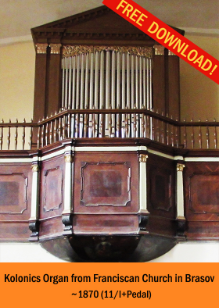
The church organ was built in 1749 by the Bavarian master Julianus Ottner. This organ was used for more than 100 years, and then István Kolonics built an one manual and pedal-operated organ with 11 stops around 1870 that is still in use today. (István Kolonics was a famous Hungarian organ builder of the 19th century, who was active mainly in the southern area of historical Hungary and in Transylvania. He made more than 500 organs. Most of his organs were small one-manual organs similar to those in Brasov.) The organ was significantly extended by the Wegenstein organ factory in the 1920s, but in 2005 this extension was completely demolished, leaving only two pedal registers, and the organ was restored to its original condition. This is how this beautiful Kolonics organ is still working, which fits very well with the acoustics of the small, almost chapel-sized church.
The following friends helped me to make and publish the sample set (in alphabetical order): Dominique Dantand, Gérard Lefranc, Nagy István and Jean-Pierre Silvestre. If something's done well, it's thanks to them. Thank you for their work. I especially thank my friend László Megyaszai, a reformed cantor from Brasov, for his help. He also obtained the recording permit and the accommodation in Brasov. I can thank him for the recording of all Transylvanian organs (Gelence, Kanta, Sepsiszentgyörgy, Brasov Reformed church, Brasso Franciscan church).