Carl Hesse style  Organ from Zalaegerszeg (Hungary)
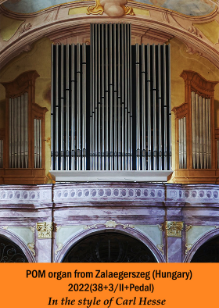
Carl Hesse style Organ from Zalaegerszeg
                                                                                             History
Zalaegerszeg is a city in Hungary, the seat of Zala County. Its population is 62,000.
In the 14th century, Zalaegerszeg was the largest town in the area. Its significance increased during the Turkish conquests, and it was Hungary's last fortress for more than 100 years. Even after the expulsion of the Turks, it was the most important city of the county. It lost its importance in the 19th century, the neighboring Kanizsa became the county seat. It began to develop again in communist times, due to its significant textile production and the petroleum found in the area. It is still the seat of Zala county and the most important city in Western Hungary next to Szombathely.

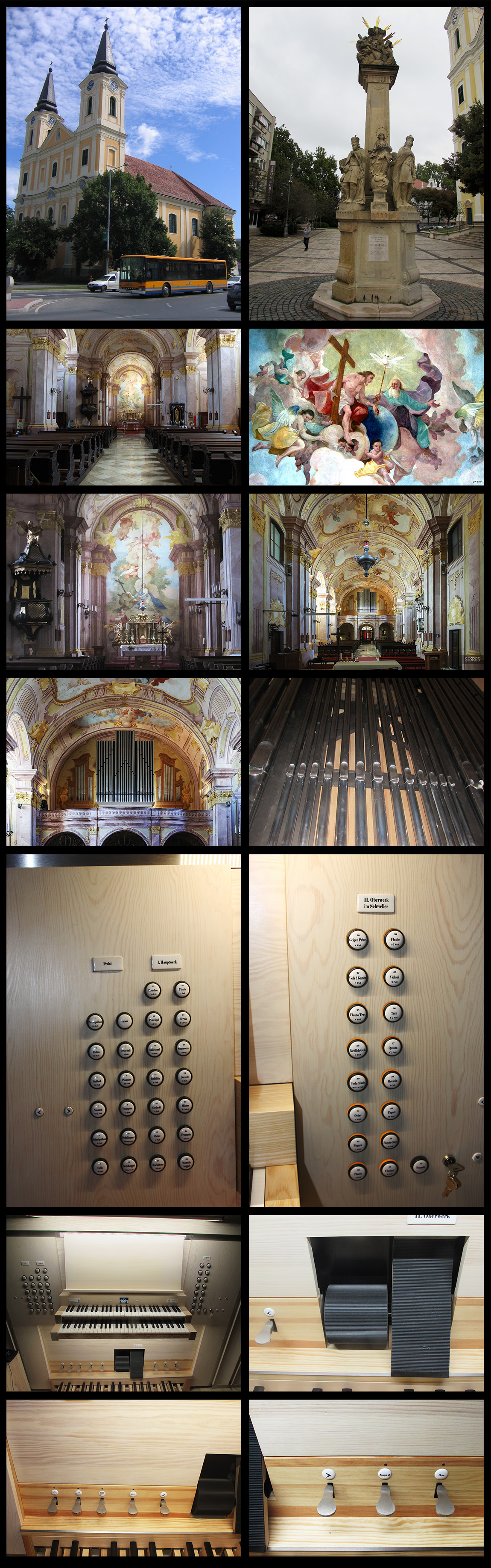
The Mary Magdalene parish church was built between 1747-1757. The huge, single-nave church is one of the most important buildings of the Hungarian Baroque. The frescoes of the church were made by the Viennese painter Johann Ignaz Cimbal. The parish priest of the church was József Mindszenty, Cardinal of Hungary, who suffered communist persecution.

The church's first organ was an 8-register baroque positive, built in 1764 by Johann Roth, a master organ maker from Sopron. This organ turned out to be too small for the huge church. The new organ was made in 1865 by Carl Hesse, a famous master organ builder from Vienna. This organ is two-manual and pedal-operated, with 26 registers. This organ served the liturgy for almost 100 years, but in II. it was irreparably damaged in World War II. The construction of a three-manual, 47-register Angster organ was planned, but this plan was thwarted by the communist takeover. A small harmonium was used, and a 9-register organ was made in 1956 from the remaining parts of the Carl Hesse organ. A small harmonium was used, and a 9-register organ was made in 1956 from the remaining parts of the Carl Hesse organ. From the 1960s, the 2-manual, 16-register Angster organ of the Zalaegerszeg synagogue, built in 1904, was used in the church. (The city's Jewish community of several thousand was deported in 1944 and exterminated in Auschwitz.) This organ required constant repairs, so it was sold and an electric organ was used from 1998. Finally, a new organ was built in the church by 2022. This two-manual mechanical instrument with 38 registers and three auxiliary registers (Tambur, Nachtigall, Zilbelstern) was built by the Pécs Organ Manufactory, based on the designs of Judit Hajdók. The organ was built in the style of Carl Hesse, paying tribute to the memory of the great Viennese organ builder, with the aim of restoring the wonderful sound of the church's Carl Hesse organ.

I owe special thanks to my friend Dezső Papp, cantor from Zalalövő. He obtained the permission to record the organ in Egerszeg, and I owe it to his intervention to obtain the permission for all my samples from Vas County and Zala County. Without his help, 2/3 of my samples could not have been made.
The following friends helped me to make and publish the sample set (in alphabetical order): Dominique Dantand, Gérard Lefranc, Nagy István and Jean-Pierre Silvestre. If something's done well, it's thanks to them. Thank you for their work. 

Features
Sample quality 
The sample sets are available in wave format 48kHz/24bit, stereo, multiple loops (1-12) and multiple releases (3 levels). a=442 Hz
The sample sets are made in three forms

a. A version of wet stereo (far)

b. A version of dry stereo (near).

c. A Surround version (3 pairs of stereo recording: near,  far and in the background (rear).

In the surround version you can adjust the perspective by setting the volume of the near, far and rear recordings. (Suitable HW loading and channel settings can be used to give wet or semidry stereo modes or 4 channel surround mode too).   

The sample set reverb is 3-3.5 s reflecting the original  acoustics of the church.  (Created IR file for HW5-7 users)

Hauptwerk v4.2 or v5-v9 supported for the Organ Definition Files.

Keyboards, Pedal 
The original organ compass of the manuals are 58 keys, the compass of the pedal is 30 keys.
Operating Instructions:

RAM requirements (GB)

2 channels sztereo

6 channels surround


16 bit

24 bit

16 bit

24 bit

Egerszeg

6

8

12

16

The data is for information only. They depend on the operating system and other apps.
Specifications  

Pedal  (original and virtual 30 keys) - 9 stops

Principalbass 16’, Violon 16’, Subbass 16', Nasardt 10 2/3’,

Principalbass 8’, Cello 8’, Octavbass 4’

Posaune 16’, Trompete 8’

I. Hauptwerk (original and virtual 58 keys) – 13 stops

Bourdon 16', Principal 8’, Salicional 8', Hohfloete 8’, Gedackt 8', 

Octav 4', Nachthorn 4', Flauto 4', Tercia 3 1/4', Superoctav 2',

Cornett 3f, Mixtura 2' 4f, Trompete 8

II. Schwell (original and virtual 58 keys) – 16 stops

Geigen principal 8’, Viola di Gamba 8’, Flauta traversa 8’,

Lieblich Gedackt 8’, Unda Maris 8’, Octav 4’, Fugara 4’, Flauto 4’,

Flauto 2 2/3’, Violini 2’, Terz 1 3/5’, Quinta 1 1/3’, Octavina 1’

Fagott 16’, Fagott-Oboe 8’, Clarinet 8’

Auxiliary registers

Tambur, Nachtigall, Zimbelstern

Couplers

original: I/P, II/P, II/I

virtual extension: II sub, II II super, II uni off

Tremulant

Original: II

Extension: I

Enclosure

original: II

Pictures
Catholic Church From Zalaegerszeg and the Organ

Audio demos

Playing Dominique Dantand, Nagy István, and Jean-Pierre Silvestre
Download / Order
Try the the demo sample sets before you buy!
The Trial Versions of the Egerszeg Organ has a limited compass of C2-C3 (048-c to 060-c) in the pedal, C2-G5 (048-c to 079-g) in the manuals. All other functions work. 

(Install the part01 of the stereo-wet version. Install the part01 and then the part02 of surround version. It is important to sort.) 

The IR file should only be downloaded and installed by anyone using Hauptwerk version 5 or 6 or 7. It is optimized for the stereo near version.


Surround vs Stereo mode

If you do not have a surround sound system, but there is enough memory (RAM), I suggest you also install the surround version. If you activate the front and rear stops too, then you will get a more compact and fuller sound than the simple stereo.

Guide: simple stereo from surround, how to?  

Buy the full (stereo and surround) Vorosbereny sample set (You can pay in dollars or euros.)


119 EUR  
129 USD