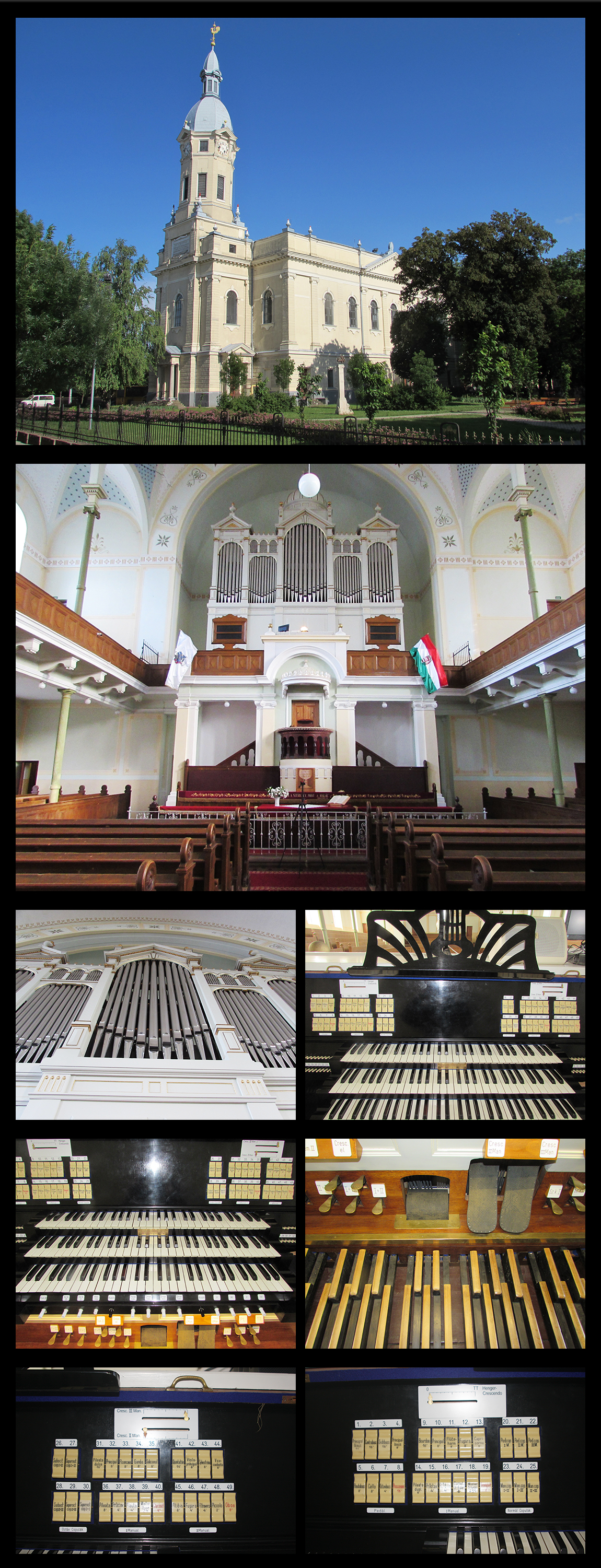
Angster  Organ from Reformed Church in Hajdúböszörmény (Hungary)
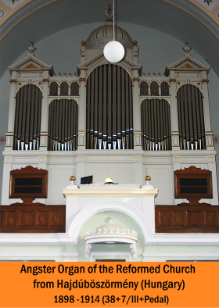
Angster organ from Hajduboszormeny (Hungary)
                                                                                             History
Hajdúböszörmény is a city of 30,000 inhabitants in the eastern part of Hungary, in the county of Hajdú-Bihar.
In the place of Hajdúböszörmény, there was already a settlement inhabited in prehistoric times. It was an important market town in the Middle Ages, the first written document mentioning the town dates back to 1248. It is the second largest city in the county of Hajdú-Bihar. The settlement structure of the city is very interesting, circular, which is typical of Hungarian cities dealing mainly with agriculture. The majority of the population is of the Reformed religion.

The Reformed Church in the Kálvin square is the second largest Reformed church in Hajdúböszörmény. It was built in a late-eclectic style and inaugurated in 1899.

The organ of the church was built by József Angster in 1898. The three manual, mechanical instruments had 33 registers. József Angster's sons (Emil and Oszkár) rebuilt this organ into a pneumatic system and expanded it to 38 registers. (Three reed registers were only planned, they were not installed.) This instrument is significant both in terms of monuments and history, because it was the last large organ of the Angster factory's heyday, and it is one of the most beautiful late-romantic organs in Europe. In communist times, regular maintenance of the organ was neglected, then the pneumatics were replaced by electromagnetic switches and thus the organ lost its wonderful unique sound. The Aeris Ltd. carried out the complete reconstruction of the highly incomplete and remodeled organ, and restored the organ to its 1914 state, as well as replacing the three missing reed registers. The organ has thus once again become one of the most beautiful late-romantic instruments of the Angster organs, on which mainly German romantic organ works can be performed authentically.

The following friends helped me to make and publish the sample set (in alphabetical order): Dominique Dantand, Gérard Lefranc, Nagy István and Jean-Pierre Silvestre. If something's done well, it's thanks to them. Thank you for their work.  I especially thank the help of the reformed cantor and organist Szabadi Árpád, who drew my attention to this great organ and obtained the necessary permission to make the sound sample.

Features
Sample quality 
The sample sets are available in wave format 48kHz/24bit, stereo, multiple loops (1-12) and multiple releases (3 levels). a=442 Hz
The sample sets are made in three forms

a. A version of wet stereo (far)

b. A verion of semidry stereo (near)

c. A Surround version (3 pairs of stereo recording: near,  front and in the background.

In the surround version you can adjust the perspective by setting the volume of the near, far and rear recordings. (Suitable HW loading and channel settings can be used to give wet or semidry stereo modes or 4 channel surround mode too).   

The sample set reverb is 2.5-2.9 s reflecting the original  acoustics of the church.  

Hauptwerk v4.2 or v5-v9 supported for the Organ Definition Files.

Keyboards, Pedal 
The original organ compass of the manuals are 58 keys, the compass of the pedal is 30 keys.
Operating Instructions:

RAM requirements (GB)

2 channels sztereo

6 channels surround


16 bit

24 bit

16 bit

24 bit

Boszormeny

7

11

15

23

The data is for information only. They depend on the operating system and other apps.
Specifications  

Pedal  30 keys

Principalbass 16', Kontrabass 16’, Subbas 16',

Quintbass 10 2/3' (extension),

Principalbass 8', Flautabass 8’, Cello 8’,

Octavbass 4’, Rauschpfeife 3x (extension)

Posaune 16' Trompet 8’ (extension), Clarin 4’+2’ (extension)

I. Manual  58 keys

Bourdon 16',

Principal 8’, Flute harm. 8’, Fugara 8’, Capri-corno 8’, Pileata 8’,

Principal-octav 4’, Flauta tibia 4’, Cornet 3-5x, Mixtur 3x,

Trompet 16’ (extension), Trompet 8’

II. Manual  58 keys

Pileata dolce 16’,

Principal 8’, Flauta concava 8’, Gamba 8’, Salicional 8’, Pileata 8’,

Principal-octav 4’, Flauta 4’, Mixtur 3x,

Clarinet 8’

III. Manual  58 keys

Quintaton 16’, Principal 8’, Flauta harmonica 8’,

Sylvestrina 8’, Vox coelestis 8’, Flauta tibia 8’,

Fugara 4’, Flauta travers 4’, Nasat 2 2/3’ (extension), Picolo 2’,

Cornet 5x (extension), Oboa 8’

Couplers

I/Ped, II/Ped, III/Ped, II/I 16, II/I, II/I 4, III/I, II/II 16, III/II, III/II 4, I 4, II 4

Tremulant

II, III

Enclosure

II, III

(The extensions was made from the organ's own sound material.)

Pictures
Reformed Church from Boszormeny, and the Angster Organ

Audio demos

Playing Dominique Dantand, Nagy István, Jean-Pierre Silvestreand Krespay Julia
Download / Order
Try the the demo sample sets before you buy!
The Trial Versions of the Angster Organ from Boszormeny has a limited compass of C2-C3 (048-c to 060-c) in the pedal, C2-G5 (048-c to 079-g) in the manuals. All other functions work. 


(First install the pack01 file. After installation, you can use the stereo-far version. Then install the pack02 file. After installation, you can use the stereo-near version. Finally, install the pack03 file. After that, you can use the 6-channel surround version. The order of installation is important, you cannot deviate from it!!) 

The IR file should only be downloaded and installed by anyone using Hauptwerk version 5-8. It is optimized for the stereo near version.

(Attention! Extensions marked in green do not work correctly in the demo version - they can produce a sound phenomenon in the lower and upper "silent" octaves.)


Surround vs Stereo mode

If you do not have a surround sound system, but there is enough memory (RAM), I suggest you also install the surround version. If you activate the front and rear stops too, then you will get a more compact and fuller sound than the simple stereo.

Guide: simple stereo from surround, how to?  

Buy the full (stereo and surround) Boszormeny Organ sample set (You can pay in dollars or euros.)


119 EUR 
129 USD