Baroque Organ of the Church of Our Lady of Help at All Times  in Bodajk (Hungary)
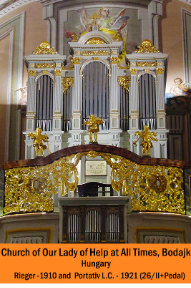
Bodajk Organ
                                                                                History
Bodajk is a small town on Transdanubia, not far from Székesfehérvár. It has 4,000 inhabitants.
Bodajk was already an inhabited settlement in the Roman and Avar times. In the early Middle Ages, the famous well of the place was the Holy-fountain, which, according to legend, dries up every seven years and is reborn one year later. The spring had a healing reputation and was already considered a place of farewell pilgrimage, the kings of the time also visited it, and St. István had a small chapel built next to the spring.

The chapel turned out to be small over time, so the Moorish Capuchins built a very beautiful baroque church between 1737 and 1768. This is the Church of Our Lady  of Help at All Times. The icon of the church is a copy of Lucas Cranach's icon of Innsbruck, which Countess Colloredo donated to the chapel in 1695. The church had a small baroque organ-positive, which was built in the 20th century. was destroyed by the beginning of the century. The Calvary and the Way of the Cross were built on the hill next to the church in 1736, which was recently reconstructed in its original state and is one of the most beautiful Ways of the Cross in Hungary. The beautifully renovated church received the rank of Basilica Minor from Pope Francis in 2023.

In 1910, an one manual and pedal organ with 10 registers was added to the church, which was made by the Rieger Organ Factory in Budapest. This organ was completely depreciated by the beginning of the 21st century. The new and young parish priest of the church, Tamás Morocz, who is an organist himself, organized a collection and received not only money, but also the pipes of old organs dismantled from Austria. Based on his plans, the organ builder Péter Takács built the new organ with a baroque layout, on a minimal budget.

 The following friends helped me to make and publish the sample set (in alphabetical order): Dominique Dantand, Gérard Lefranc, Nagy István and Jean-Pierre Silvestre. If something's done well, it's thanks to them. Thank you for their work. A special thanks goes to parish priest Tamás Morocz, who made it possible to record the organ.

Features
Sample quality 
The sample sets are available in wave format 48kHz/24bit, stereo, multiple loops (1-8) and multiple releases (3 levels). a=440 Hz
The sample sets are made in three forms

a. A version of wet stereo (far)

b. A version of semidry stereo (near)

b. A Surround version (3 pairs of stereo recording: close (near); at distance (far) and in the background (rear).

In the surround version you can adjust the perspective by setting the volume of the near, far and rear recordings. (Suitable HW loading and channel settings can be used to give wet or semidry stereo modes or 4 channel surround mode too).   

The sample set reverb is 3 s reflecting the original  acoustics of the church.  (Created IR file for HW5-8 users)

Hauptwerk v4.2 or v5-9 supported for the Organ Definition Files.

Keyboards, Pedal 
The organ compass of the manuals are 56 keys, the compass of the pedal is 30 keys.
Operating Instructions:

RAM requirements (GB)

stereo

surround


16 bit

24 bit

16 bit

24 bit

Bodajk

6

7

13

15

The data is for information only. They depend on the operating system and other apps.
Specifications  

Pedal  (original and virtual 30 keys)

Subbass 16', Octavbass 8', Bourdonbass 8', Quintbass 5 1/3', Koralbass 4’

Posaune 16', Trompete 8' (from man. I),

Clairon 4+2’ (just virtual, from Trompete 8’)

Great (original and virtual 56 keys)

Principal 8', Bourdon 8', Oktav 4', Rohrflöte 4’, Quint 2 2/3’,

Superoktav 2’, Blockflöte 2’, Mixtura 4x 1 1/3’

Trompete 8'

Positiv (original and virtual 56 keys)

Geigen Principal 8', Gedackt 8', Principal 4', Hohlflöte 4'. Nasat 2 2/3’

Oktav 2', Terz 1 3/5’ , Quint 1 1/3’, Septim 1 1/7’, Superoktav 1’

Couplers:

P+I, P+II, I+II

Tremulant: II

Enclosure: II (just virtual version)

Pictures
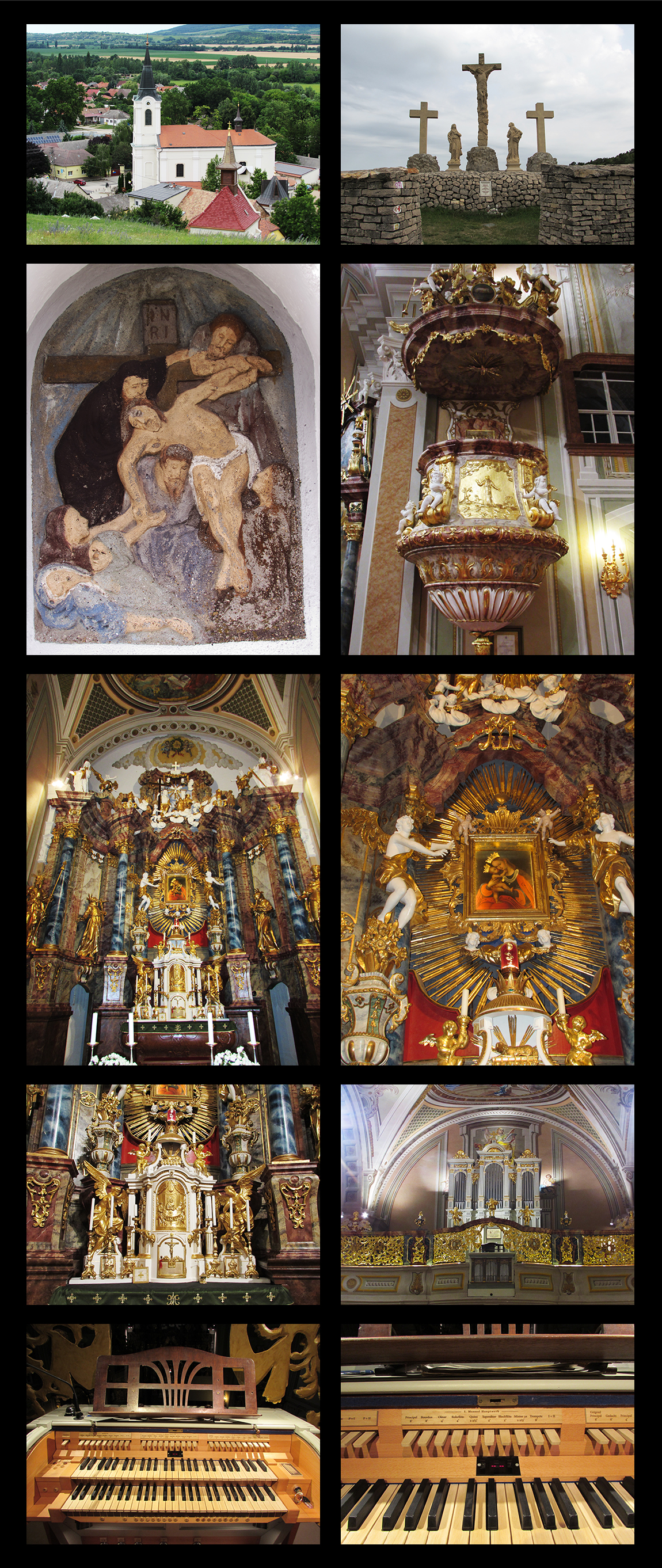
The Church of Bodajk, and Organ

Audio demos

Playing Dominique Dantand, Nagy István, Ralph Paland and Jean-Pierre Silvestre
Download / Order
Try the the demo sample sets before you buy!
The Trial Versions of the Bodajk Organ has a limited compass of C2-C3 (048-c to 060-c) in the pedal, C2-G5 (048-c to 079-g) in the manuals. All other functions work. 


(First install the pack01 file. After installation, you can use the stereo-far version. Then install the pack02 file. After installation, you can use the stereo-near version. Finally, install the pack03 file. After that, you can use the 6-channel surround version. The order of installation is important, you cannot deviate from it!!) 

If you are using one of Hauptwerk versions 5-8, you can install and use the church IR file.


Surround vs Stereo mode

If you do not have a surround sound system, but there is enough memory (RAM), I suggest you also install the surround version. If you activate the front and rear stops too, then you will get a more compact and fuller sound than the simple stereo.

Guide: simple stereo from surround, how to?  


Buy the full (stereo and surround) Bodajk sample set (You can pay in dollars or euros.)


49 EUR  
55 USD